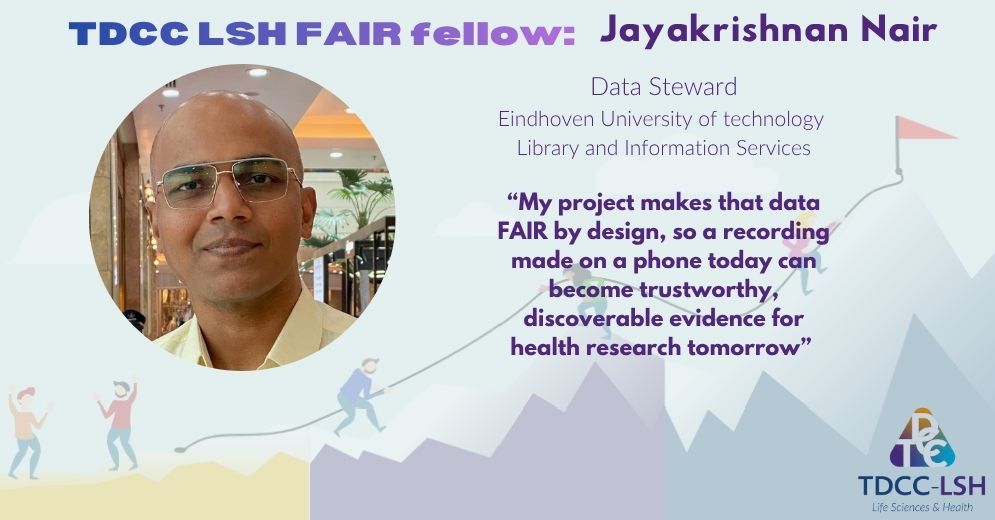
LSH FAIR fellow: Jayakrishnan H R Nair
Bio
I am a data and research professional bridging complex data and meaningful insight. As a Data Steward at Eindhoven University of Technology, I help researchers manage data responsibly — applying FAIR principles, research data management (RDM) and data ethics — and design ontologies and knowledge graphs with semantic web technologies to make that data interoperable and reusable.
Across roles at LORIA, the Blue Brain Project and TU/e, I have partnered with scientists, engineers and data providers to turn heterogeneous data into well-governed, reusable resources, building consensus on interoperability standards along the way. My foundation is in neuroscience: I hold a PhD from the University of Fribourg, where my thesis explored the basal forebrain's contribution to default mode network regulation, applying signal processing and machine learning to neurobiological time series.
Use Case Title
FAIR by Design: From Wearable Sensor Recordings to Discoverable, Reusable Research Data
Use Case Description
Wearable and smartphone sensors generate high-frequency, multi-channel time-series data, yet it is rarely reusable: exports arrive as undocumented CSVs, with implicit units, sampling rates and device differences that are lost the moment recording stops. This use case turns those ad-hoc recordings into standards-compliant, citable research objects.
Data is captured with the SensorLogger app, then described and validated through the FAIR Data Station using a purpose-built "wearable" metadata package that maps each session and sensor stream onto the ISA hierarchy. The LEAF layer semantically enriches the data — binding observations to SOSA/SSN, units to QUDT, and full provenance to PROV-O — while bulk signals are stored efficiently via InfluxDB Line Protocol.
The WIDE infrastructure then assigns persistent identifiers, licences and access policies, making each dataset findable and reusable. The result is a reproducible pipeline delivering Findable, Accessible, Interoperable and Reusable wearable sensor data without reinventing existing standards.
Matched FAIR Fellowship Coach
Team UNLOCK. Visit the profile here!
What are the biggest challenges you anticipate facing in your use case over the next months?
- Device/platform inconsistency — the biggest. The same settings produce different real data on different phones.
- Several fields (units, measured property, calibration status) are inferred by us, not reported by SensorLogger
- Getting the custom package to validate in FAIRDS
What specific skills or knowledge do you hope to gain through the fellowship programme?
Through this fellowship I hope to deepen my practical expertise in semantic data modelling and FAIR data stewardship — designing reusable metadata schemas, applying community ontologies such as SOSA/SSN, QUDT and PROV-O, and validating linked data with ShEx/SHACL.
I also want hands-on experience with the surrounding infrastructure — ISA tab format, and repository workflows — so I can confidently take wearable sensor data all the way from raw capture to discoverable, reusable research objects
What motivated you to apply for this TDCC LSH fellowship?
I applied because the TDCC-LSH fellowship to work on an interesting use case that I like — making wearable sensor data FAIR — and its mission to build FAIR data competence across Life Sciences & Health gives me the community, mentorship and standards expertise to turn a single project into reusable infrastructure the community and the domain can adopt.
In one compelling sentence, why does your project matter?
My project makes that data FAIR by design, so a recording made on a phone today can become trustworthy, discoverable evidence for health research tomorrow.
Want to connect with Jay? Use LinkedIn