
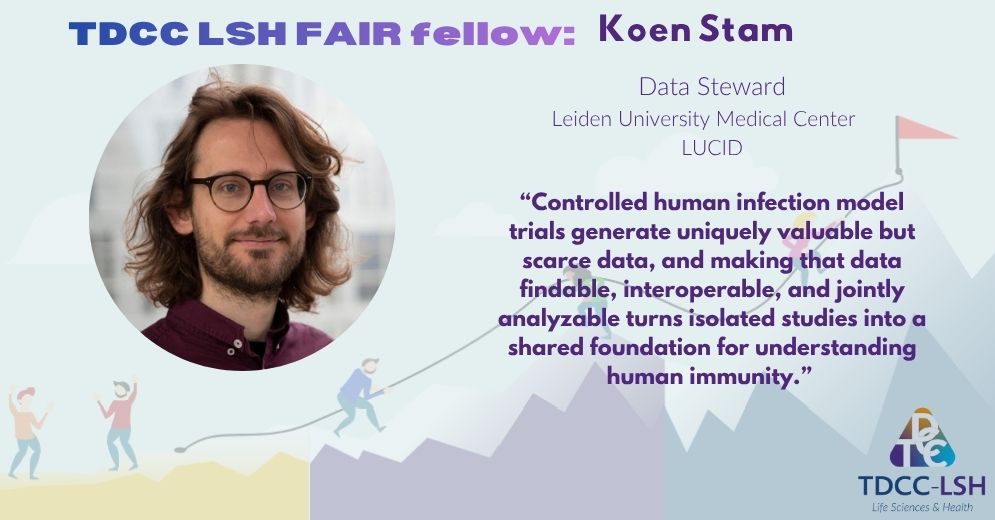
LSH FAIR fellow: Koen Stam
Bio
I am a researcher at Leiden University Medical Center, where I work at the intersection of biomedical data science, immunology, and FAIR data infrastructure.
I support my colleagues in the infectious diseases department with any data-related questions, and I'm currently developing an R package called beFAIR that helps harmonize clinical and experimental datasets.
I collaborate with researchers across the globe in various consortia, tackling questions like why vaccines sometimes fail to trigger the immune response they're designed for.
What excites me is the puzzle that combines everything: building dashboards and tools that turn biomedical data into something people can explore, question, and act on. That’s why I'm a strong believer that science moves faster and further, when it's open and collaborative.
Use Case Title
FAIRifying clinical data from controlled human infections models together with experimental flowcytometry data.
Use Case Description
At LUCID we are building a pipeline to make data from controlled human infection models findable, accessible, and reusable for researchers.
These trials typically involve small numbers of participants, which makes reuse and cross-study combination of this data especially valuable. Our first objective is to publish these metadata on a FAIR data point and register it in the Health-RI data catalogue. This increases both the visibility of these valuable studies and opportunities for collaboration.
The second objective is applying ontologies and controlled vocabularies to key data elements, so the data can be meaningfully understood and combined with other datasets and platforms.
Lastly, the third objective is focussed on exploring federated data analysis for flow cytometry data. Our cellular immune system is a key player in any health and disease related questions.
Together, these objectives move CHIM data from isolated and hard-to-find to discoverable, interoperable, and jointly analyzable — turning single, resource-intensive trials into building blocks for a shared understanding of human immunity. .
Matched FAIR Fellowship Coach
Team Bioimaging & ACDC. Visit the profile here!
Team UNLOCK. Visit the profile here!
What are the biggest challenges you anticipate facing in your use case over the next months?
I feel there is a very strong mismatch between what researchers want and need versus what the current landscape offers or what the FAIR community is pushing.
I believe we can really bridge this gap by working together and applying a more bottom-up approach — starting from the messy reality of how researchers actually collect and use data, rather than from a top-down standard they are expected to adopt.
Getting buy-in from busy clinical researchers, who often see FAIR-ification as extra overhead rather than a direct benefit to their own work, will likely be one of the harder practical challenges.
What specific skills or knowledge do you hope to gain through the fellowship programme?
I hope to gain more experience with translating FAIR principles into tools and workflows that researchers will actually want to use — including hands-on knowledge of ontology mapping and semantic modeling for complex, multi-modal datasets like flow cytometry.
I'm also keen to learn more about federated analysis approaches, and how other domains within TDCC LSH are tackling similar interoperability challenges, so I can bring that thinking back into infectious disease research.
What motivated you to apply for this TDCC LSH fellowship?
The collaborative nature of the fellowship. Challenges like these need various perspectives, both from a technical viewpoint, but also creative. It's in the nature of a fellowship to stimulate such an environment.
In one compelling sentence, why does your project matter?
Controlled human infection model trials generate uniquely valuable but scarce data, and making that data findable, interoperable, and jointly analyzable turns isolated studies into a shared foundation for understanding human immunity.
Want to connect with Koen? View the research profile on ORCID.