LSH FAIR fellow: Joeri Kalter
Bio
Joeri Kalter is a Data Steward at the Division of Human Nutrition and Health at Wageningen University & Research, where he supports researchers in implementing FAIR data practices and improving research data management.
His work focuses on enhancing metadata quality, data discoverability, accessibility, and long-term reuse, helping research teams manage and share their data more effectively. Joeri has a multidisciplinary background in physiotherapy, lifestyle and chronic disorders, psychology, coping behaviour, and cancer rehabilitation.
He completed his PhD on exercise and psychosocial interventions to improve quality of life in patients with cancer. Drawing on both research and data stewardship experience, Joeri is committed to making life sciences and health data more transparent, interoperable, and reusable.
He is particularly interested in metadata harmonization, ontology mapping, and knowledge graph approaches to support cross-study data integration and collaboration.
Use Case Title
FAIR Metadata Catalogue for HNH Research Data.
Use Case Description
This use case aims to develop a structured, interoperable metadata framework for research data within HNH at WUR. At present, data are fragmented across chair groups, stored in isolated formats, and often lack standardized metadata, limiting discoverability, interoperability, and reuse, including of historical datasets. Addressing this is essential for aligning with FAIR principles and enabling integrative nutrition and health research.
The project will design and implement a harmonized metadata model to improve the findability and accessibility of HNH data. This includes defining a minimal metadata profile based on standards such as Dublin Core and the ISA framework, mapping study-specific variables to relevant domain ontologies such as FoodOn, STATO, and Gene Ontology, and establishing governance for metadata curation and maintenance across chair groups.
The project will also explore integration of metadata into a knowledge graph, enabling datasets to be linked through shared concepts and relationships. Building on initiatives such as GO FAIR and Health-RI, a pilot knowledge graph will demonstrate cross-study discovery and interoperability. Expected outcomes include a documented metadata schema, implementation guidelines, a pilot knowledge graph, and recommendations for embedding FAIR-by-design practices into future workflows. This will enhance data reuse, collaboration, and large-scale data-driven research in nutrition and health.
Matched FAIR Fellowship Coach
Team Biodiversity and Ecology. Visit the profile here!
What are the biggest challenges you anticipate facing in your use case over the next months?
The biggest challenges are likely to be organizational and semantic rather than technical. HNH data may vary widely across chair groups in format, quality, terminology, and documentation, making harmonization difficult. Achieving agreement on a minimal metadata profile, ontology choices, and governance responsibilities may require substantial coordination.
Legacy datasets may lack sufficient metadata for FAIR reuse, requiring time-consuming curation. Sustained adoption is another key risk: researchers need incentives, training, and easy-to-use workflows to apply metadata standards consistently.
Finally, integrating metadata into a scalable knowledge graph requires technical expertise and long-term maintenance.
What specific skills or knowledge do you hope to gain through the fellowship programme?
Through the fellowship, I aim to gain advanced, hands-on skills in metadata harmonization, ontology mapping, and knowledge graph implementation for real-world life sciences and health data. I want to deepen my ability to design interoperable metadata frameworks that make research data machine-readable, reusable, and suitable for cross-study integration.
I also hope to strengthen strategic skills in stakeholder engagement, governance design, and aligning FAIR solutions with institutional policies and researcher workflows. In return, I bring practical experience in data stewardship, community engagement, workshops, and translating complex FAIR concepts into actionable guidance, contributing actively to peer learning and shared solutions.
What motivated you to apply for this TDCC LSH fellowship?
As a data steward at HNH, WUR, I support researchers in improving FAIR data practices, particularly around findability, accessibility, metadata quality, and data management planning. I want to further develop my expertise in metadata management, data integration, and interoperability to better support researchers and strengthen FAIR implementation within my division and university.
The fellowship offers a valuable opportunity to gain hands-on experience, learn from a national network of FAIR professionals, and contribute to shared solutions. I am also motivated to bring these insights back to WUR and support sustainable FAIR practices.
In one compelling sentence, why does your project matter?
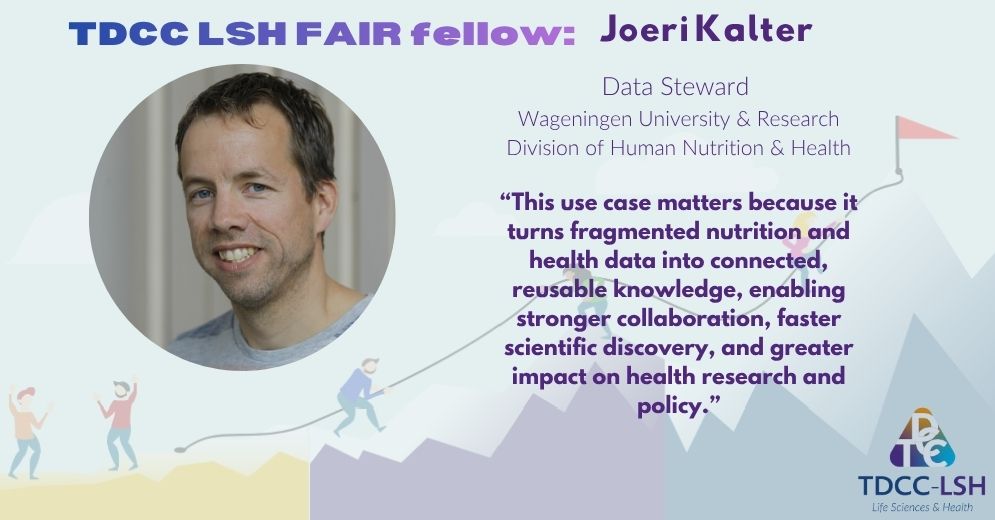
This use case matters because it turns fragmented nutrition and health data into connected, reusable knowledge, enabling stronger collaboration, faster scientific discovery, and greater impact on health research and policy.
Want to connect with Joeri? Use LinkedIn or view the research profile on ORCID.