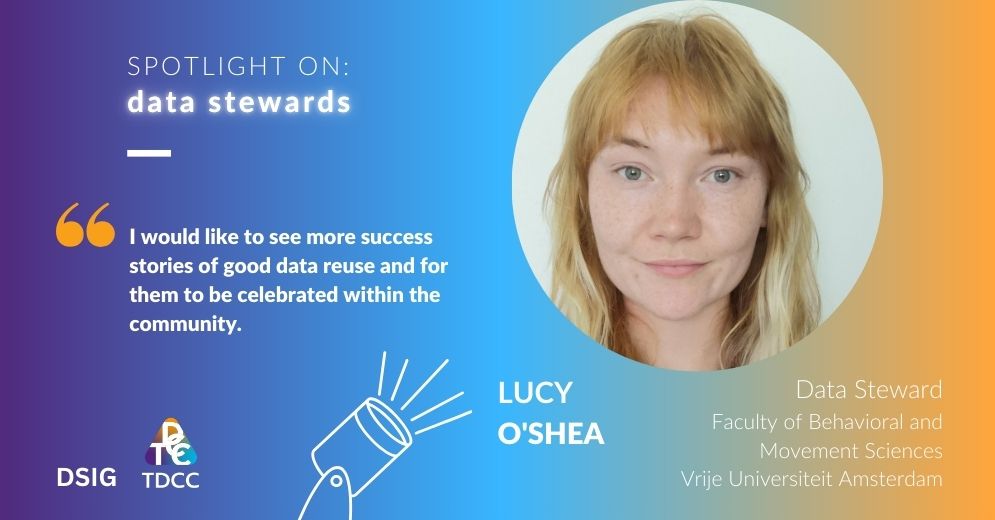
Spotlight on: Lucy O'Shea
Every other week, the Thematic DCCs and the Data Steward Interest Group (DSIG) put the spotlight on one research data steward working in the Netherlands to stimulate knowledge exchange and peer-to-peer learning.
What drew you towards the research data management field?
I have a strong interest in how research transparency contributes to promoting research integrity and how it intersects with the ethical (re)use of data. Luckily, during my MLS, I had the opportunity to engage in courses on research data management, data ethics, and scholarly communication. Through this, I learned about the growing field of Research Data Management within universities and the important role that data stewards play in supporting and promoting sustainable and ethical research practices.
What is an activity/task of your role that you find yourself looking forward to?
I enjoy building relationships with researchers and being involved in projects from start to finish. I find it especially rewarding to hear researchers discuss their work and to gain insight into the progress and developments that occur over time.
What is something unexpected that you can offer help with, if a colleague reaches out to you?
Alongside being a data steward, I am a privacy champion in the faculty. This means I also support researchers with privacy compliance and data privacy related questions.
What do you think your community of research data professionals is missing?
I would like to see more success stories of good data reuse and for them to be celebrated within the community. Especially in domains that are generally considered 'hard to share'. Hearing more from others about their experiences helps establish good standards and enables us to learn from one another.
What is a topic you would want to collaborate on with others?
I would like to collaborate with others to improve the sustainability of data reuse for data that is 'available upon request'. As awareness grows around the importance of making data as open as possible and as closed as necessary, I am concerned that restricted data may end up in a 'dark zone' where it is findable through online repositories but not truly accessible because the processes required to request and obtain it are unclear or poorly established.
Could you point us to a resource, learning platform, tool or similar which you find useful or inspirational?
The DANS Guidebook for Depositing Restricted Data and its associated protocol are valuable resources. I find this guide particularly useful and would love to see more organizations adopt and implement this protocol.
Get in touch with Lucy on LinkedIn
Do you want to read other interviews published in the Spotlight on series? Visit the series' page.