LSH FAIR fellow: Katia Roque Molina
Bio
I am the Research Data Steward for the Erasmus School of Health Policy and Management (ESHPM) and part of the Engagement and Research Services (ERS) department at Erasmus University Rotterdam (EUR). At ERS, I work within the Open and Responsible Science team to support open science goals and improve the university's research data management infrastructure. As part of ERS, I perform different tasks. For example, I am a member of one of the Digital Competence Centre capability teams, focusing on research data management and output management. I also represent the data stewards at EUR as part of the Compliance Support Research project, which aims to harmonize the review process for ethical and legal compliance in research projects.
At ESHPM, I serve as the first line of support for researchers on all matters related to research data management. My role involves assisting researchers in aligning their data management practices with open science principles and promoting the implementation of FAIR data practices. I provide guidance on data management planning, secure data storage, project organization, data documentation, responsible data sharing (including repository selection), and long-term archiving. As part of my support to researchers, I also deliver training sessions focusing on research data management topics.
Use Case Title
FAIR kit: Tools for structuring research projects for documentation, metadata, and facilitating reuse
Use Case Description
My project for this TDCC-LSH fellowship aims to develop a practical toolkit designed to help researchers structure their projects from the beginning of their research in ways that support documentation for different approaches to research within the health domain, including research that bridges the health domain with social sciences. The toolkit promotes more consistent metadata recording and, therefore, facilitates long-term reuse. The aim of the project is to lower the barriers to adopting FAIR principles in the daily workflows of researchers.
At ESHPM, researchers often struggle with finding practical examples of how to apply FAIR principles. They frequently wonder where to start, what steps to follow, and how to prepare their outputs for reuse. One of the main challenges at ESHPM is treating metadata and documentation as an afterthought. This FAIR kit aims to encourage FAIR-by-Design by creating a toolkit with adaptable templates for different types of research conducted at ESHPM, offering examples for structuring project folders and various types of documentation.
Matched FAIR Fellowship Coach
Team UNLOCK. Visit the profile here!
What are the biggest challenges you anticipate facing in your use case over the next months?
One of the main challenges I expect to face in this project lies in designing resources that are flexible enough to accommodate the diverse research practices at ESHPM, while still providing sufficient structure to ensure they are useful. Research at ESHPM is interdisciplinary in nature; therefore, researchers generate different data types and workflows. Moreover, they have varying levels of familiarity with metadata, and this poses a challenge in creating templates that feel relevant without being overly generic.
An additional challenge is ensuring that the toolkit is not perceived as adding to the administrative burden but rather as a set of tools that support existing workflows. The tools and examples should be clear, practical, and easy to implement. The project will also explore the potential integration with Surf Yoda, ensuring that the added benefits of such an integration are evident to researchers.
Finally, another challenge is ensuring that the toolkit can meaningfully support collaboration with clinical and biomedical research contexts without relying on standards that may not fit or be applicable to social science researchers at ESHPM. Updating the toolkit beyond the project lifecycle will also be crucial to ensuring it remains useful and relevant. Embedding the project within university-wide infrastructure can contribute to this goal.
What specific skills or knowledge do you hope to gain through the fellowship programme?
First of all, I would develop hands-on experience in applying FAIR principles to different approaches to research, especially in contexts where no clear standards exist. I would also learn to design adaptable metadata practices that are not overly technical, as well as to structure research outputs for reuse, starting with project folder organization as a foundation for translating abstract FAIR concepts into concrete workflows. Additionally, I would gain familiarity with a range of such workflows across disciplines. I also hope to develop skills in making research outputs understandable and usable for researchers with different methodological backgrounds.
What motivated you to apply for this TDCC LSH fellowship?
I applied to this fellowship because I hope to better support ESHPM researchers. Given the wide range of research conducted at the faculty (including healthcare governance, health law and ethics, sociomedical sciences, health services management and organization, technology use in care, health economics, health systems, and insurance), I am motivated to assist in bridging the gap between health research within biomedical contexts and communities working on health policy and the social dimensions of health-related fields. ESHPM research has the potential to significantly improve healthcare and inform health-related policy. Fostering a FAIR-by-design culture among researchers can further increase the impact of this research.
In one compelling sentence, why does your project matter?
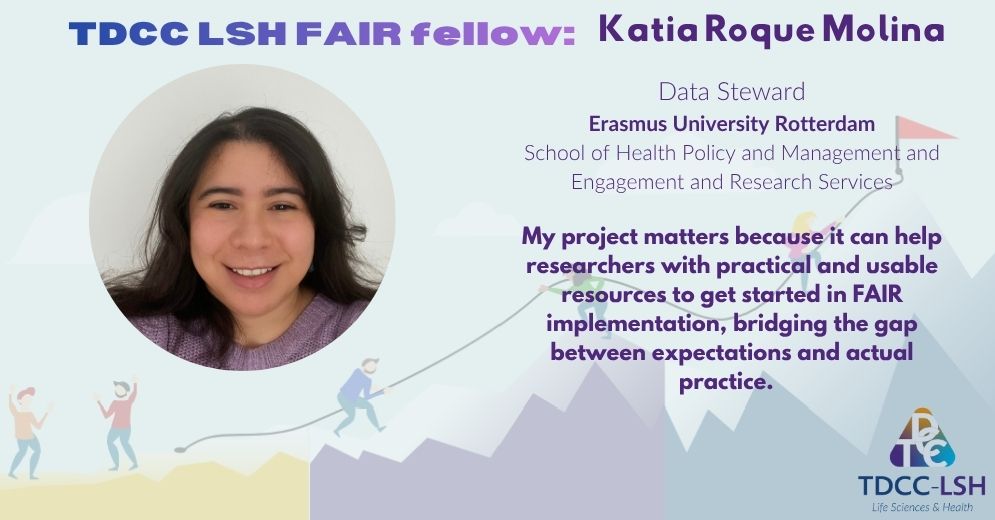
This project matters because it can help researchers with practical and usable resources to get started in FAIR implementation, bridging the gap between expectations and actual practice.
Want to connect with Katia? Use LinkedIn.