Connecting Knowledge: Tackling Interoperability in Research
Authors: Walter Baccinelli, Vedran Kasalica, Kathrin Füllenbach, Dani Metilli, Alex Brandsen
On 21st May 2026, a room full of researchers, data stewards, developers and research support organisations representatives gathered in Utrecht for a one-day event dedicated to discussing interoperability in research: what does interoperability really mean in practice? Why does it remain difficult to achieve? How can different research communities work together to make data, software and research infrastructures more connected?
Hosted by the three Dutch Thematic Digital Competence Centres (TDCCs), the event brought together representatives from across the Natural & Engineering Sciences (NES), Life Sciences & Health (LSH), and Social Sciences & Humanities (SSH) to jointly discuss these topics.
Setting the scene: Why interoperability matters
The morning began with an introduction by Joanne Yeomans (TDCC-NES) to the work of the TDCCs and the motivation behind organising this cross-domain event. While each TDCC supports a different research domain, interoperability is a challenge that cuts across all disciplines. Whether researchers work with engineering data, biomedical resources or cultural heritage collections, they all face the same fundamental question: how can research outputs be made easier to discover, understand and reuse?
Interoperability sits at the heart of the FAIR principles. While Findability, Accessibility and Reusability often receive considerable attention, the organisers reminded participants that interoperability is what allows these principles to scale across disciplines, infrastructures and research communities. It is both an investment in future research and a prerequisite for meaningful collaboration. The objectives for the day reflected this broader vision. Rather than searching for a universal solution, participants were invited to connect disciplines, learn from one another's practices, identify opportunities for collaboration and explore the next steps towards a more interoperable research landscape.
Keynote: Looking beyond technology
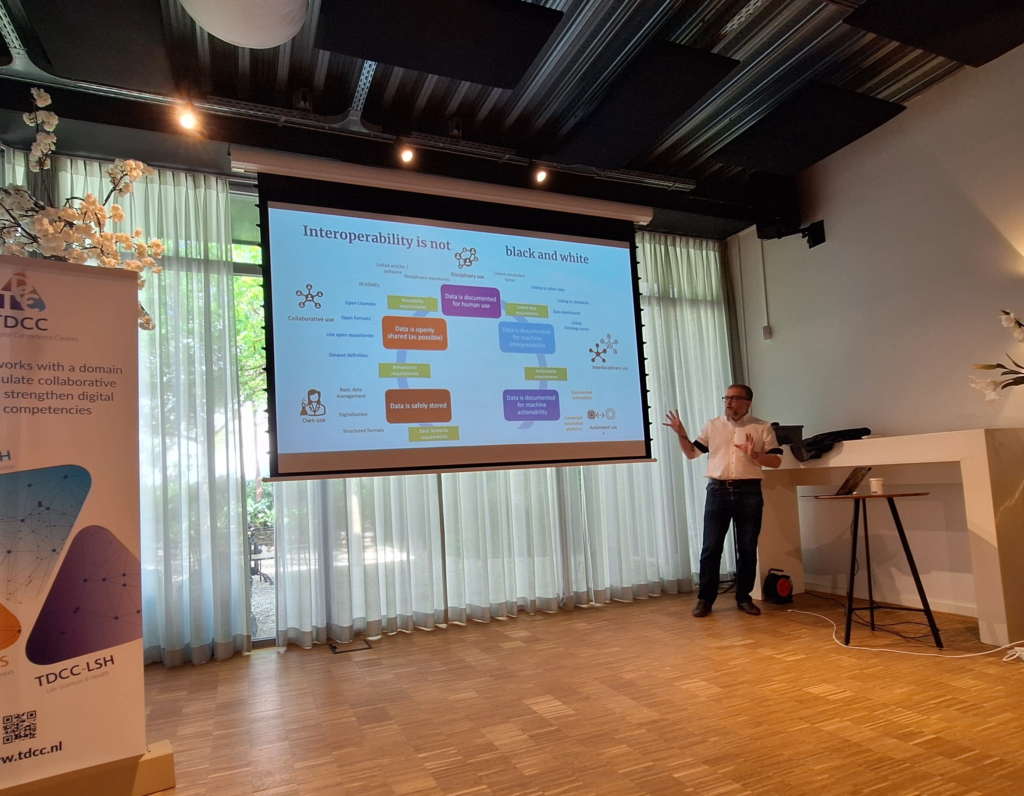
The keynote presentation by Ari Asmi (TU Delft / Leiden University) challenged one of the biggest misconceptions surrounding interoperability: that it is primarily a technical problem.
Instead, Ari argued that technology is only one piece of a much larger puzzle. Researchers encounter numerous barriers on their path towards interoperability, including knowledge gaps, limited skills, unclear responsibilities, fragmented communities and insufficient technical support. Yet perhaps the most important obstacle is motivation. Researchers often understand that interoperability is desirable, but they struggle to see how the additional effort benefits their own research.
As Ari pointed out, interoperability is frequently described through technical definitions involving metadata schemas, ontologies and linked data. While these concepts are essential, they can easily appear distant from the daily reality of conducting research. Without concrete examples and compelling success stories, interoperability risks remaining something that researchers perceive as an abstract requirement rather than a practical enabler.
An important insight from the keynote was that interoperability should not be viewed as an all-or-nothing objective. Instead, it exists on a spectrum. Good data management practices form the foundation, followed by structured formats, machine-readable documentation, linked vocabularies and eventually machine-actionable data that can be integrated automatically across infrastructures. Every step along that continuum adds value, even if researchers never reach the highest level of semantic interoperability.
The keynote concluded with a call to shift the conversation from technical implementation towards demonstrated benefits. Rather than asking researchers to invest more effort for the sake of compliance, the community should better communicate how interoperability improves efficiency, increases scientific impact and enables new forms of collaboration.
Lightning talks: Three domains, one shared challenge
The lightning talks demonstrated how different research communities are addressing interoperability while facing remarkably similar questions.
Representing the Natural & Engineering Sciences, Anas Abdelrazeq (RWTH Aachen University) illustrated the importance of semantic interoperability through one of the best-known examples in engineering history: the Mars Climate Orbiter, which was lost because different teams used incompatible unit systems. Although dramatic, the example perfectly illustrated why common vocabularies and shared semantics matter. As engineering research produces ever larger volumes of heterogeneous data, ontologies, metadata schemas and knowledge graphs are becoming essential building blocks for connecting information across projects and organisations.
Yet technology alone will not drive adoption. Despite the growing availability of ontologies and semantic tools, many researchers still perceive interoperability as too complex or as additional work that provides little immediate reward. The presentation therefore ended with a clear call for easier tools, greater automation, stronger support structures and continued investment in education.
The Life Sciences & Health perspective, presented by Tooba Abbassi Daloii (Amsterdam University Medical Center), highlighted the work of the ELIXIR Interoperability Platform. Rather than developing isolated technical solutions, ELIXIR brings together experts from across Europe to coordinate standards, best practices and FAIRification activities. Through resources such as the FAIR Cookbook, RDMkit and FAIRsharing, the platform helps researchers discover, access, integrate and analyse biological data while encouraging the adoption of common metadata standards and identifiers.
Perhaps most importantly, ELIXIR approaches interoperability as an ongoing community process. FAIRification is not treated as a one-off exercise but as a continuous cycle of collaboration, learning and refinement, supported by shared frameworks and practical use cases.
From the Social Sciences and Humanities, Maria Eskevich (Huygens Institute / KNAW) focused on documentation as a key ingredient for interoperability. Cultural heritage datasets are exceptionally diverse, making rich documentation essential for ensuring that collections remain understandable and reusable beyond their original context.
Instead of relying solely on standard metadata, the proposed approach combines foundational descriptions with additional contextual information, creating layered documentation that supports both human interpretation and machine processing. The presentation demonstrated that interoperability is not simply about exchanging data, but about preserving meaning across communities with very different perspectives and practices. Although each presentation focused on a different domain, a common thread emerged: interoperability succeeds when technical standards are accompanied by shared understanding, community engagement and practical support.
Panel discussion
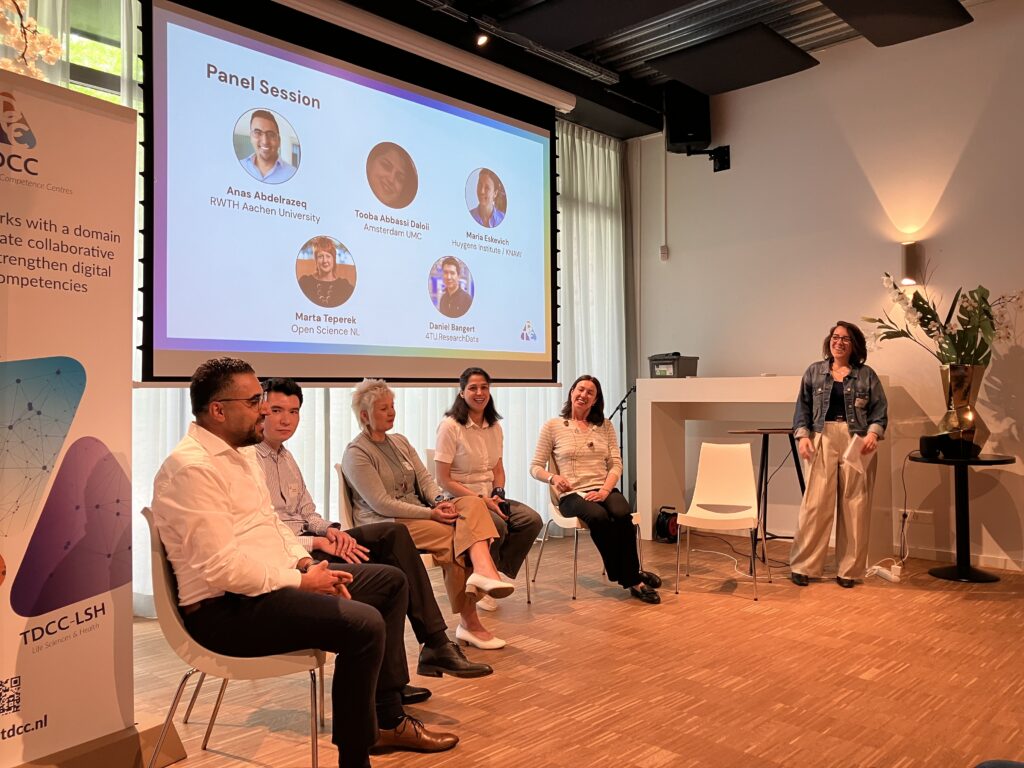
The panel discussion, moderated by Alessandra Soro (4TU.ResearchData), brought together the three speakers from the lightning talk session alongside Marta Teperek (Open Science NL) and Daniel Bangert (4TU.ResearchData). While the perspectives varied, the conversation consistently returned to one central question: who is responsible for making interoperability happen?
The discussion reflected one of the recurring themes introduced earlier in the day. Researchers cannot shoulder this responsibility alone. Universities, research infrastructures, funders, support staff and national organisations all have a role to play in creating the conditions that make interoperable research possible.
During the question round, Egon Willighagen (Maastricht University) brought the discussion to a positive close by reminding attendees not to lose sight of how far the research community has already come in recent years.
Breakout Sessions: Getting Hands-On
That collaborative spirit continued into the afternoon's breakout sessions, where participants explored interoperability from three complementary perspectives.
Working with Ontologies: A Practical Workshop
The Natural & Engineering Sciences workshop introduced participants to practical work with ontologies through a hands-on deep dive into ontology engineering using a real record from the ShareTrait project containing measurements for an individual fish. The pen-and-paper exercise allowed participants to identify core concepts and the relationships between them before formalising them in Protégé. Working in groups, the participants developed an ontology in OWL and formulated their first logical axioms. The participants particularly appreciated the accessible format and the combination of theory and practice. There was also interest in applying these methods across different stages of the research lifecycle and in a variety of fields, as well as in future collaborations and similar workshops tailored to other domains, such as the building industry.
How Interoperable Are Our Tools, Really? Frameworks, Gaps, and Feasibility
The Life Sciences & Health session revolved around the topic of research software interoperability, and how can it be tackled by developers.
Participants examined software registries such as bio.tools and the Research Software Directory , discussing how federated registries, shared metadata standards and domain ontologies can improve software discovery and reuse. Conversations also explored the limitations of current metadata standards, the challenges of automated annotation, the potential role of GitHub integration and even the use of AI to extract software metadata. Rather than seeking a perfect solution, the workshop identified practical opportunities for improving software interoperability while laying the groundwork for a white paper containing community guidelines.
Interoperability through Lego – explore interoperability challenges
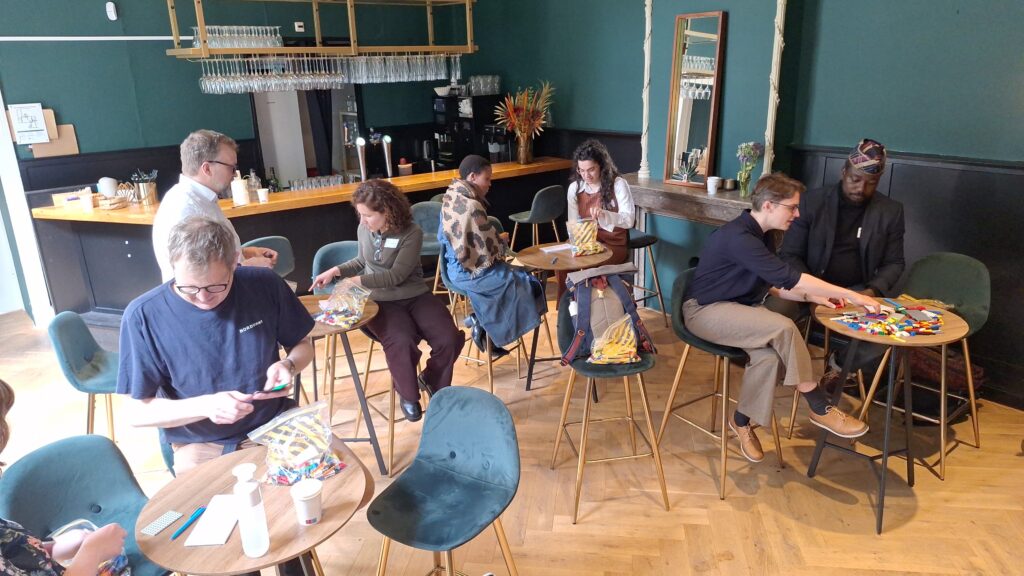
The Social Sciences & Humanities breakout took an entirely different approach. Participants were asked to build bridges using LEGO bricks, and used this as teaching method for concepts related to interoperability.
“Both halves were Open, but neither was Interoperable”
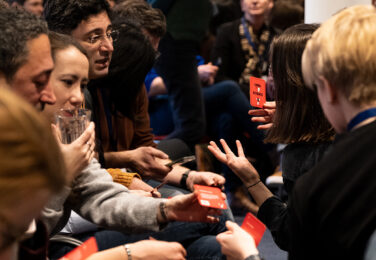
Groups of participants were tasked to conceptually discuss their bridge design, and then independently build one half of a bridge each. Of course, miscommunications and assumptions arose which made the bridges hard to connect in the middle. While LEGO pieces themselves are incredibly interoperable at a technical level, to build a bridge you also need semantic interoperability to agree on how to join 2 bridge halves (or 2 systems or datasets!). This practical demonstration set the scene for an in-depth discussion between participants on interoperability in their own disciplines. The group agreed that interoperability is not about controlling designs or uniformity, but about agreeing on how to join up on the parts that matter.
Building infrastructures that researchers actually use
The afternoon concluded with a thought-provoking presentation by Rory Macneil (RSpace) and Guido Aben (SUNET), who shifted the discussion from interoperability itself to the research infrastructures that support it.
They argued that many existing virtual research environments are highly sophisticated but designed primarily for expert users. While these bespoke systems deliver impressive functionality, they are expensive to maintain, difficult to scale and often too complex for the majority of researchers.
The speakers challenged the community to rethink how digital research infrastructures are designed. Instead of expecting researchers to navigate increasingly complicated technical ecosystems, infrastructures should provide lightweight, user-friendly platforms that allow researchers to combine services as easily as people connect smart devices at home.
This vision represents another dimension of interoperability: not simply making systems compatible, but making them accessible. If interoperability is to become routine rather than exceptional, it must reduce complexity rather than introduce additional barriers.
A shared journey
The event concluded with an open discussion on next steps and reflections from participants. Although many challenges remain, from fragmented standards to limited training and evolving infrastructures, the outlook is optimistic.
Throughout the day, speakers repeatedly emphasised that the Netherlands already possesses considerable expertise, strong national initiatives and an active community working on interoperability. The challenge now is to connect these efforts more strategically, strengthen collaboration across domains and communicate the practical value of interoperability more effectively.
Perhaps the most important takeaway from the day is that interoperability is often discussed in terms of metadata, ontologies and technical standards, but its real purpose is much simpler: enabling people to work together more effectively. When researchers, software developers, data stewards and infrastructure providers build shared understanding alongside shared technology, interoperability becomes far more than a technical objective. It becomes the foundation for more collaborative, more cross-sectional, more efficient and ultimately more impactful research.