LSH FAIR fellow: Esther Hazelhoff
Bio
I began my career in neuroscience, specializing in chronobiology. During this time, I discovered that I really enjoyed working with data. This led me to transition into data management which naturally evolved into data stewardship, following developments such as the European Health Data Space.
I currently work for Health Data Space Utrecht, where I focus on making healthcare data FAIR. My work includes developing a regional catalogue, currently only containing cohort data, and contributing to national data model discussions for cohort.
For this fellowship, I am expanding my focus from cohort data to include electronic patient record data (EPD). In this context, I will be working on making EPD data more findable and searchable through catalogues, with the aim of improving its usability for research and care.
Use Case Title
Automated Integration of Health DCAT-AP Metadata from External Data Platforms into the Internal Data Catalogue
Use Case Description
Electronic patient record data is inherently complex, and there are many different EPD systems in use, all of which need to be adequately represented in a catalogue. This makes it challenging to provide clear and consistent descriptions, especially while respecting strict privacy requirements around sensitive personal data.
This project focuses on how to make EPD data more findable and understandable for secondary use without exposing confidential information or introducing bias. It aims to develop structured, high-level descriptions that provide meaningful insight into available data while respecting privacy and governance constraints.
In addition, a key part of the project focuses on designing a reusable system for mapping different EPD systems to our catalogue data model. This should enable consistent disclosure in the catalogue and support reuse of mappings across regions and contexts.
The overall goal is to improve discovery and responsible reuse of EPD data in research and healthcare.
What are the biggest challenges you anticipate facing in your use case over the next months?
A key challenge in this project is the high level of heterogeneity across EPD systems, which differ in structure, terminology, and granularity, making it difficult to create consistent catalogue descriptions. In addition, developing reusable mappings across such heterogeneous systems is complex, as mappings are often context-dependent. Finally, there is currently limited standardisation for how EPD systems should be described at catalogue level, requiring alignment between clinical, technical, and governance stakeholders to reach usable and sustainable solutions.
What specific skills or knowledge do you hope to gain through the fellowship programme?
I want to deepen my understanding of data mappings and how to make them scalable and reusable across different contexts and systems. In particular, I want to learn how to design and maintain mappings that can evolve over time without losing consistency or requiring constant reinvention. I also want to strengthen my skills in building and working with APIs, especially in the context of healthcare data exchange and catalogue systems.
What motivated you to apply for this TDCC LSH fellowship?
I applied for this fellowship because I want to learn how other institutions approach similar challenges. I’m especially motivated by the fact that a lot of work is being done in parallel, often solving similar problems from scratch in different places. I’d like to help change that by finding ways to reuse each other’s work—like mappings, models, and approaches—so we can build on what already exists instead of duplicating effort. For me, this fellowship is a chance to work more collaboratively and contribute to a more connected way of working with healthcare data.
In one compelling sentence, why does your project matter?
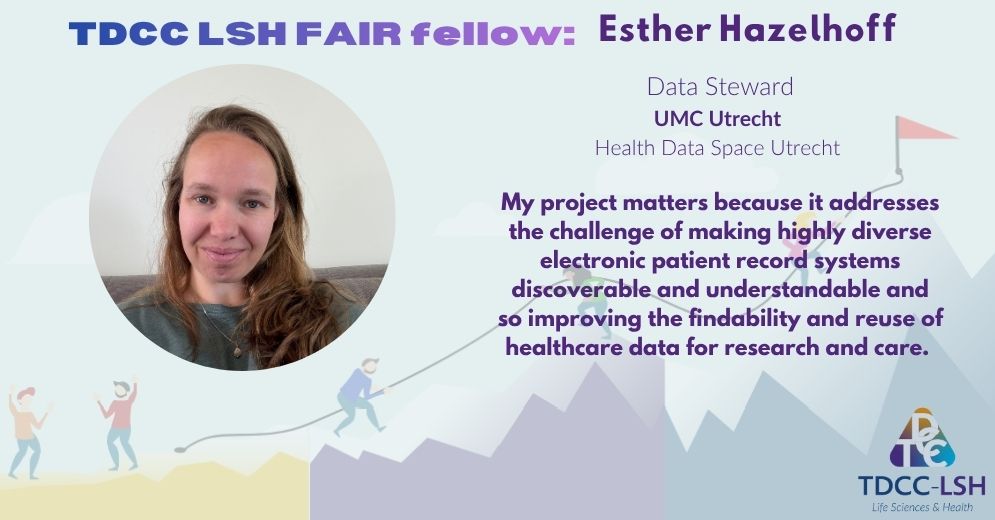
This project matters because it addresses the challenge of making highly diverse electronic patient record systems discoverable and understandable and so improving the findability and reuse of healthcare data for research and care.
Want to connect with Esther? Find her on LinkedIn.