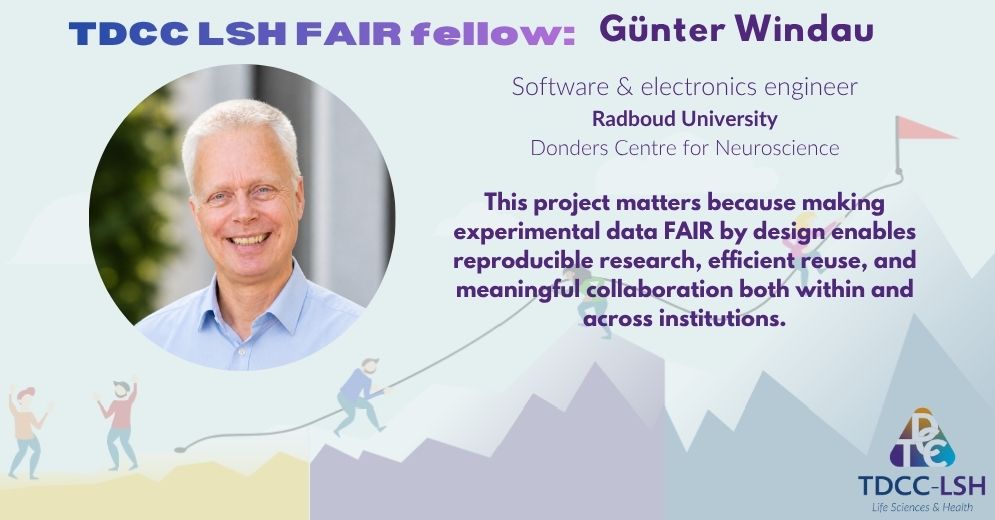
LSH FAIR fellow: Günter Windau
Bio
I am an engineer and data professional at DCN with a background in medical electrical engineering, signal processing, software development, safety, and research data management. My work focuses on supporting complex experimental research setups, where I combine technical system design with practical data stewardship. I’m closely involved in projects that generate large heterogeneous data sets, including clinical and scientific measurements of neurophysiological and psychophysical measurements.
Use Case Title
FAIR Data Discovery During Ongoing Research
Use Case Description
This use case focuses on improving the FAIRness of complex, multi-modal datasets generated in experimental and clinical research settings, such as the OtoControl 2.0 project. These datasets include electrophysiological recordings, imaging data, psychophysical measurements, and device configuration data, collected across multiple centres (located in the Netherlands, Germany, Denmark and Switzerland) and platforms.
The current data infrastructure supports storage and analysis but relies heavily on project-specific conventions, limiting interoperability and reuse. The goal of this project is to design and implement a FAIR-by-design approach that integrates metadata capture, standardised data structures, and documentation directly into the data acquisition and processing workflow. Therefor we will develop a software based solution that implements these concepts and is directly usable for all participating researchers in the OtoControl 2.0 project, where each can as well upload data, as access all relevant data from other participants.
Key elements include defining a metadata model, aligning data formats with community standards where possible. The project will also explore practical ways to embed FAIR principles into existing technical systems without increasing the burden on researchers.
The outcome will be a set of implementable patterns and guidelines for handling complex research data in a way that supports reuse, reproducibility, and cross-institutional collaboration.
Matched FAIR Fellowship Coach
Primary coach: Team UNLOCK. Visit the profile here!
What are the biggest challenges you anticipate facing in your use case over the next months?
The main challenge will be to develop a technical solution for automated data exchange with a central repository that is legally acceptable to the participating institutes across Europe.
What specific skills or knowledge do you hope to gain through the fellowship programme?
I hope to expand my expertise in metadata modelling, interoperability, and FAIR implementations strategies for (complex) datasets. In particular, I want to learn how to translate FAIR principles into concrete technical solutions, including schema design, workflow integration, and alignment with existing standards and infrastructures. I also want to gain insight into approaches used in other domains facing similar challenges.
What motivated you to apply for this TDCC LSH fellowship?
I have been working as a data steward at DCN since January 2025, so research data management is still a relatively new field for me. Within Radboud University and the Donders Institute, there is a strong network of colleagues involved in data management and research support. This provides a productive environment to develop skills through practical, hands-on applications.
At the same time, the FAIR fellowship offers a valuable opportunity to broaden this perspective by connecting with data stewards from other Dutch universities and UMCs. It enables exchange of use cases, mutual learning, and collaboration on shared challenges.
In one compelling sentence, why does your project matter?
This project matters because making experimental data FAIR by design enables reproducible research, efficient reuse, and meaningful collaboration both within and across institutions.
Want to connect with Alex? Use LinkedIn or view the research profile on Radboud University Website.