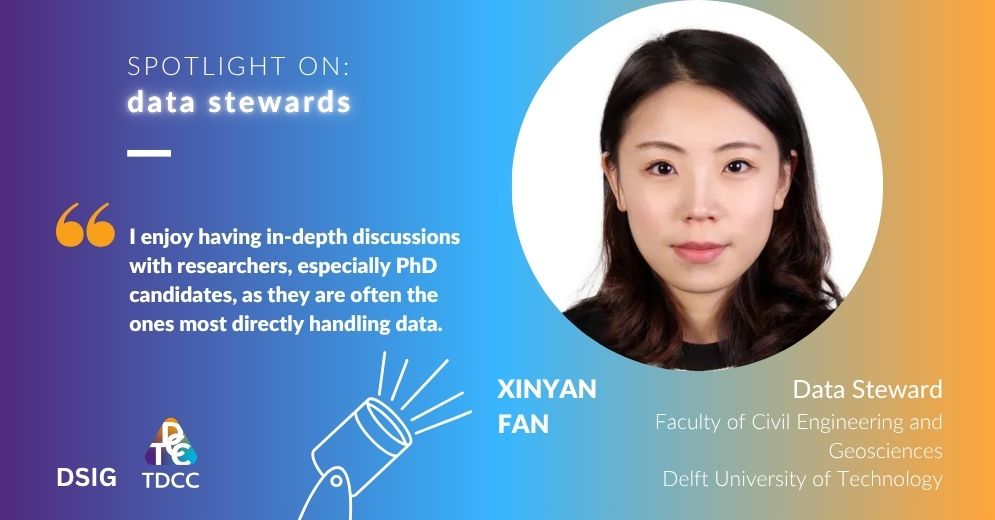
Spotlight on: Xinyan Fan
Every other week, the Thematic DCCs and the Data Steward Interest Group (DSIG) put the spotlight on one research data steward working in the Netherlands to stimulate knowledge exchange and peer-to-peer learning.
What drew you towards the research data management field?
I see great potential and still significant room for improvement in this field, especially in today's era of increasingly data-driven research and widespread use of AI across disciplines. Researchers are required to dedicate more efforts and recognize the importance of establishing robust data management practices in determining the success of either an individual PhD project or a broader collaborative project. My experience working with big-scale geospatial data integrated into complex deep learning frameworks reinforces this view and I find it exciting to witness its development and to contribute to its progress along the way.
What is an activity/task of your role that you find yourself looking forward to?
When time allows, I enjoy having in-depth discussions with researchers, especially PhD candidates, as they are often the ones most directly handling data. As I engage more in these discussions, I begin to notice patterns in research workflows and data needs within particular domains. I see these as valuable opportunities to build domain-specific RDM knowledge, which I hope will in turn enable me to provide more professional support in identifying infrastructure requirements and advising on implementation methods for large-scale collaborative projects. That said, it’s not always easy to have the capacity to provide in-depth support like this.
What is something unexpected that you can offer help with, if a colleague reaches out to you?
I position myself uniquely as a bridge between academia and the research support world, which naturally brings me into contact with a wide range of needs that are not always directly related to data stewardship. Many of them may be new to me, but I have never seen them as unexpected. This ultimately gives me a broader and more practical perspective when discussing FAIR data and software practices in researchers’ daily work.
What do you think your community of research data professionals is missing?
I see great value in providing in-depth support and establishing data systems tailored to common workflows within a discipline. A key benefit is the improvement of published data quality. One way to achieve this could be through pilot projects focused on several major research domains at a high level, creating a model that can then be adapted across the disciplines within them. I also see value in embedding increasingly important topics such as interoperability and instrument management within clear domain-specific scopes, as this can strengthen both discipline-specific RDM and broader FAIR implementation.
What is a topic you would want to collaborate on with others?
Domain-specific RDM initiatives and associated AI-powered tools.
Could you point us to a resource, learning platform, tool or similar which you find useful or inspirational?
Publications in the Data Science Journal (https://datascience.codata.org). You’ll find many impressive achievements and experiences of FAIR implementation shared by research groups across disciplines worldwide.
Get in touch with Xinyan Fan on ORCID and LinkedIn
Do you want to read other interviews published in the Spotlight on series? Visit the series' page.