LSH FAIR fellow: Karen Sap
Bio
Karen Sap is a Data Steward at Amsterdam UMC, working at the intersection of research data management, metadata standards, and high-performance computing. She supports researchers and core facilities in making complex biomedical datasets—such as genomics, proteomics, metabolomics, and imaging data—FAIR by design.
Within her work, Karen focuses on translating FAIR principles into practical, sustainable workflows. She has extensive experience with metadata modeling using the ISA framework, repository submissions, and aligning domain-specific standards with national and international initiatives such as Health-RI. She is particularly interested in bridging the gap between hands-on research practices and interoperable data infrastructures.
As a TDCC-LSH FAIR Fellow, Karen aims to contribute to community-driven solutions for FAIR data stewardship by sharing practical experiences, developing reusable templates and workflows, and strengthening collaboration between data stewards, researchers, and infrastructure providers.
Use Case Title
FAIR metadata framework for GEN-BioDORA.
Use Case Description
GEN-BioDORA is Amsterdam UMC’s digital genomics databank within ADORE, designed to support secure, FAIR, and GDPR-compliant management of sensitive genomic data. It is being developed as the foundational layer of a broader institutional multi-omics platform, alongside PRO-BioDORA (proteomics) and BioDORA (clinical and phenotypic data).
The use case focuses on designing and prototyping a FAIR-by-design metadata and governance framework that enables:
- Internal findability and traceability of datasets
- Responsible reuse of sensitive data, and
- Future multi-omics integration
Key objectives
- Design researcher-friendly ISA-based metadata templates for genomic assays (WES)
- Explore alignment between ISA and genomics-specific standards, including EGA submission models.
- Define how consent, data-use conditions, and provenance can be represented in metadata.
- Develop patterns for describing integrated and cross-omics analyses in a FAIR manner.
Translate FAIR principles into practical, implementable workflows within Amsterdam UMC.
What are the biggest challenges you anticipate facing in your use case over the next months?
An actual challenge is the maturity and integration of the tools currently being developed and used for FAIR metadata workflows, particularly FAIR Data Station (FDS) and FAIRDOM-SEEK. These tools are still evolving, and their usability, interoperability, and alignment with local infrastructure are not yet fully established. A key part of the fellowship will therefore be exploring how these tools can realistically support FAIR-by-design metadata workflows within GEN-BioDORA.
A more general challenge will be translating FAIR and metadata standards into workflows that are practical and usable for researchers working with genomic data. While standards such as ISA provide a strong conceptual framework, adapting them to genomics use cases and institutional infrastructure requires careful design and iteration.
Other challenges are:
- Deciding which metadata fields are important for GEN-BioDORA WES assay.
- Understanding how FAIR Data Station (FDS) and FAIRDOM-SEEK can be used together in practice and identifying gaps or limitations in the current workflow.
What specific skills or knowledge do you hope to gain through the fellowship programme?
Through the fellowship, I hope to:
- Learn how to apply and adapt the ISA framework for genomics use cases (e.g., WES) and future multi-omics integration.
- Gain practical experience with FAIR-by-design metadata workflows, including validation and cataloguing.
- Better understand how tools such as FAIR Data Station (FDS) and FAIRDOM-SEEK can be used together in practice.
- Strengthen my skills in metadata modeling and identifier design for dataset traceability;
- Learn from other institutions’ real FAIR implementation experiences in the life sciences domain.
What motivated you to apply for this TDCC LSH fellowship?
I applied for the TDCC-LSH FAIR Fellowship because I am currently working on the development of GEN-BioDORA, Amsterdam UMC’s digital genomics databank, at a stage where FAIR principles and metadata design can still be embedded from the start. The fellowship offers a valuable opportunity to learn from others implementing FAIR data practices in the life sciences and to connect with a national network of data stewards facing similar challenges. This will help me strengthen both my own expertise and the practical implementation of FAIR data stewardship within Amsterdam UMC.
In one compelling sentence, why does your project matter?
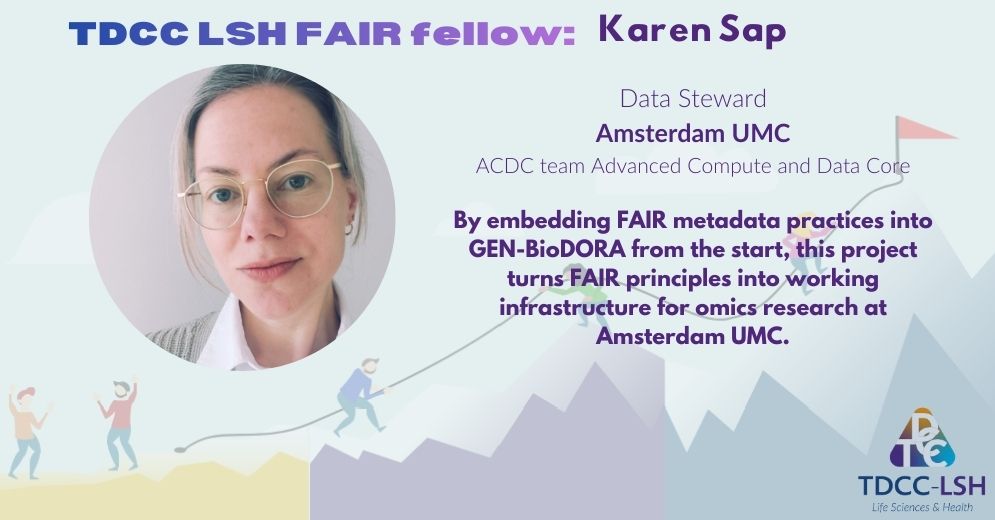
By embedding FAIR metadata practices into GEN-BioDORA from the start, this project turns FAIR principles into working infrastructure for omics research at Amsterdam UMC.
Want to connect with Karen? Use LinkedIn or view the research profile on ORCID.