LSH FAIR fellow: Alex van der Jagt
Bio
I started off as a project coordinator for several research projects within the developmental psychology department at the Vrije Universiteit Amsterdam in 2016. During this time, it was very common to be given the role as “Data Manager” on top of any other role you might have. In the years after this, I worked hard to be recognized as an (almost) full time Data Manager.
This succeeded and I currently work as Data Manager for the Nederlands Autisme Register (NAR) and several other smaller projects and act as departmental Data Steward. Furthermore, I do some minor programming and development on a cognitive tasks tool for the iPad for VU researchers. This position ensures that I am very in tune with the theoretical and practical aspects of data.
Use Case Title
Working towards a FAIR blueprint for data interoperability across long-term cohort studies.
Use Case Description
We recently acquired a grant to work towards data harmonization (“Nothing about us without us”). We intend to centralize and professionalize the data infrastructure of several registries (Nederlands Autisme Register (NAR), Nederlands Tweelingen Register (NTR), and InKaart) at VU Amsterdam and in this process make the data interoperable and secure.
Even though these registries have a lot in common such as the data infrastructure and types of data collected, there are challenges in combining the data and metadata of these projects in a way that the data can be (machine) findable and be made interoperable.
During the fellowship, I will be learning about available tools with which this data harmonization can be achieved as well as receive training in how to work towards data harmonization. The steps required and concrete requirements to create an infrastructure to support this will be documented and disseminated current and future cohort studies within and outside of the VU.
Furthermore, through this training and knowledge acquisition, I hope to disseminate the knowledge to the Research Data management support staff within the VU and outside of the VU and play a central part in discussions and questions regarding interoperability and reusability.
Matched FAIR Fellowship Coach
Primary coach: Team NPEC. Visit the profile here!
Secondary coach: Team Systems Genetics. Visit the profile here!
What are the biggest challenges you anticipate facing in your use case over the next months?
The biggest challenge I anticipate in this fellowship is to identify all the moving parts first and combining these elements into a workable whole. In rough lines, I have a good idea what I want to achieve, but the way to get there is yet unclear.
Furthermore, my experience and expertise are more focused on the TDCC-SSH domain, which might mean that the use and availability of fellowship materials and mentorship might not always be an exact match. I expect that a lot of individual effort and work will be required.
What specific skills or knowledge do you hope to gain through the fellowship programme?
There are some main skills. For one, managing and executing a bigger project by myself is something that I have not done before. My work tasks for projects I am involved with are very concrete and bite sized. For the more fundamental or bigger projects I have worked on, the timelines are less strict, and the work is more individualistic. Via this fellowship, I hope to gain good grasp on how to tackle big projects in a cooperative context.
As for the content of this fellowship, knowledge about tools and methods to make data interoperable and reusable are the focus and something I plan to learn a lot about. Currently, this knowledge is lacking both within the department I work at and the Vrije Universiteit as a whole.
What motivated you to apply for this TDCC LSH fellowship?
My motivation for applying is tied to the “Nothing about us without us” grant. This fellowship has the potential to help me obtain the knowledge and work with tools to concretely apply to this project. Furthermore, I am very involved with VU-wide research data and software management teams. Via the fellowship, I want to become better at knowledge dissemination throughout the whole network and give advice on similar use-cases for other projects.
In one compelling sentence, why does your project matter?
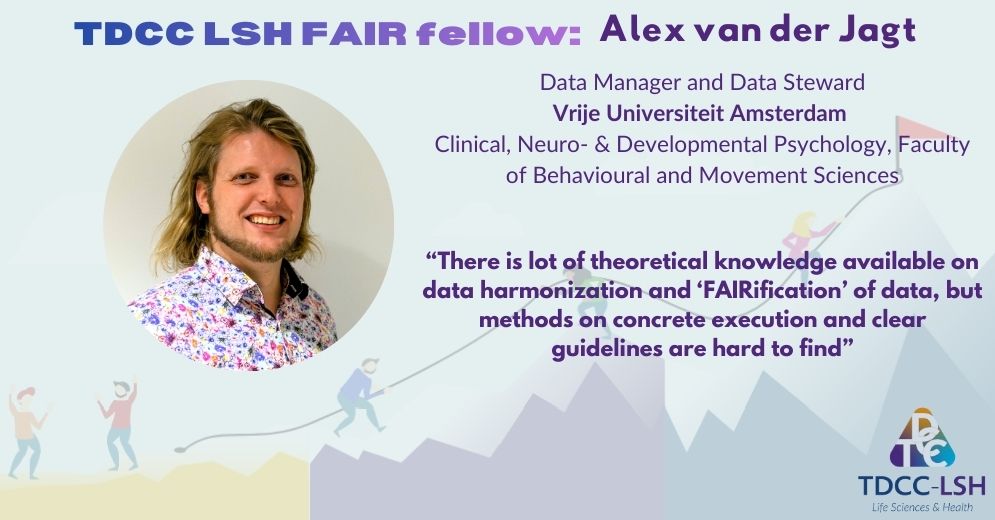
My project matters because there is lot of theoretical knowledge available on data harmonization and ‘FAIRification’ of data, but methods on concrete execution and clear guidelines are hard to find.
Want to connect with Alex? Use LinkedIn or view the research profile on ORCID.