LSH FAIR fellow: Sara Mokhtar
Bio
Sara Mokhtar is a Data Steward at MEMIC, data shared within The Maastricht Study at Maastricht University / MUMC+. With a background in Epidemiology and a PhD focused on ocular biomarkers and neurodegeneration, she combines scientific research expertise with advanced data stewardship. Sara supports researchers in managing complex life sciences datasets, including imaging, clinical, and registry data, ensuring data quality, reproducibility, and regulatory compliance. Her work bridges research practice and FAIR data implementation, helping multidisciplinary teams translate data management principles into sustainable operational workflows. As a TDCC-LSH FAIR Fellow, she focuses on harmonising cardiology registry data and strengthening scalable, interoperable metadata infrastructures across hospital departments.
Use Case Title
FAIRification of the mCMP Cardiology Registry: From Local Clinical Data to Interoperable Research Infrastructure.
Use Case Description
This use case focuses on the FAIRification of the mCMP (multidisciplinary Cardiomyopathy) registry within Maastricht UMC+. The registry contains rich longitudinal clinical data on cardiomyopathy patients, including imaging, laboratory, and clinical outcomes data. Currently, the dataset is valuable but primarily structured for local clinical use.
The project aims to transform this registry into a FAIR-by-design resource by improving metadata quality, applying standardized terminologies, mapping variables to common data elements, and exploring alignment with broader standards such as OMOP where appropriate. A key objective is to create a practical decision framework that supports sustainable metadata annotation and interoperability across hospital departments.
By embedding FAIR principles into routine workflows rather than treating them as an afterthought, this project contributes to scalable, reusable cardiology data that can support national and international collaboration, while remaining compliant with ethical and legal requirements.
What are the biggest challenges you anticipate facing in your use case over the next months?
The main challenges include harmonising heterogeneous legacy data, balancing clinical workflow constraints with FAIR implementation, and aligning multiple stakeholders with varying levels of FAIR maturity. Additionally, translating conceptual FAIR principles into practical, sustainable processes within a busy hospital environment requires careful coordination and clear governance structures.
What specific skills or knowledge do you hope to gain through the fellowship programme?
I hope to deepen my expertise in metadata standards, semantic interoperability, and FAIR evaluation tools. In particular, I aim to strengthen my ability to design scalable FAIR workflows, apply ontology mapping strategies, and assess datasets using practical FAIR testing frameworks that can be communicated clearly across departments.
What motivated you to apply for this TDCC LSH fellowship?
I applied because I see an urgent need to move from theoretical FAIR discussions to concrete implementation within clinical research environments. With increasing international collaborations and initiatives such as the European Health Data Space (EHDS), preparing clinical and registry data in a harmonised and interoperable manner is no longer optional but essential. Establishing a sustainable FAIR infrastructure is therefore an urgent priority to ensure that data can be securely shared, responsibly reused, and aligned with international standards. The fellowship provides a unique opportunity to collaborate with national experts, exchange best practices, and accelerate the development of practical FAIR solutions within real-world healthcare settings.
In one compelling sentence, why does your project matter?
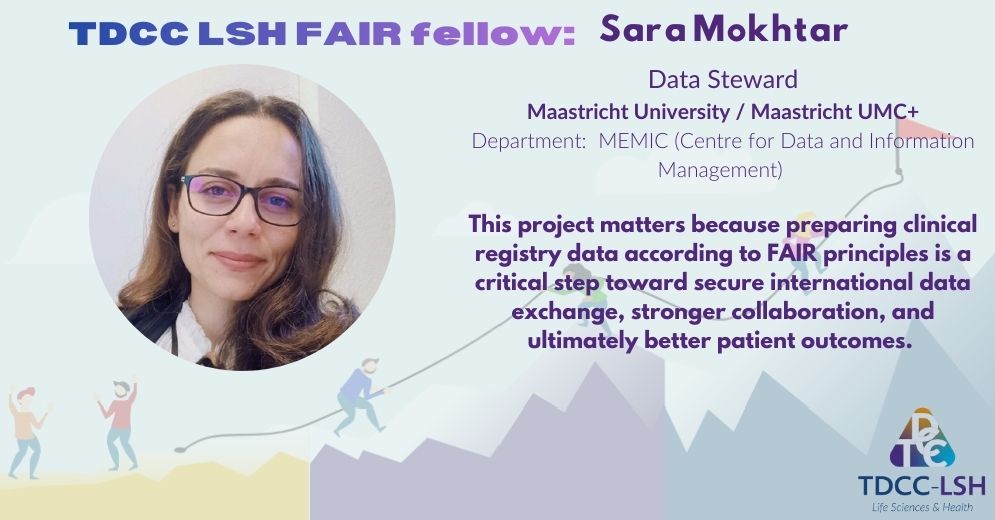
This project matters because preparing clinical registry data according to FAIR principles is a critical step toward secure international data exchange, stronger collaboration, and ultimately better patient outcomes.
Want to connect with Sara? Find her on LinkedIn or view her research profile on ORCID.