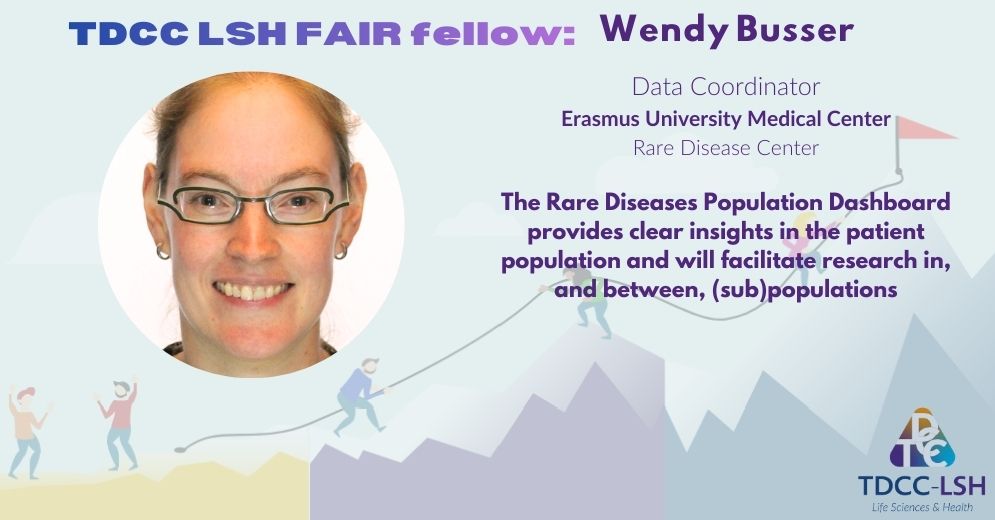
LSH FAIR fellow: Wendy Busser
Bio
Since obtaining a master's degree in Technical Medicine, I have been working in clinical research in multiple clinical domains and various settings. This has provided me insights in working with both large data sets and smaller populations, as well as in setting up national data registries. At the Erasmus MC Rare Disease Center, I am currently working in the field of rare diseases where extracting clinical data is of great importance yet challenging. We aim to identify and map the rare disease population within the Erasmus MC by using data directly from the source. The goal is to create an accurate and updated digital platform of clinical and research data of rare disease patients at Erasmus MC. The FAIR Fellowship Programme will provide more knowledge on data infrastructures, data modelling and mapping, and the best practices on how to integrate FAIR for the rare disease community.
Use Case Title
Erasmus MC Rare Diseases Population Dashboard.
Use Case Description
In clinical research the availability of data is often a problem. This is an even more pressing issue in rare diseases. The numbers of patients per disease are limited, patients are being treated by different specialisms, and data is not collected in a standardized process or in a standardized format. Within the Erasmus MC Rare Disease Center, I am developing a data platform that identifies and maps patients with rare diseases and their exact diagnoses by extracting data recorded in the Electronic Patient File (EPF). The goal is to create an accurate and updated digital platform of clinical and research data of rare disease patients.
In the EPF, diagnosis registration varies between, and even within, specialisms as the ORPHA coding is not yet implemented well enough for accurate registration. Apart from that, data is often written and stored as free text. We would like to improve semantic operability in all data that is collected and build a database in which rare disease data can be found and where sub-selections can be made for specific research questions. To do so, we will map the data to several ontologies and (meta)data models. Furthermore, we will develop a pipeline through which relevant data automatically flows from the EPF to our rare disease patient database. Ultimately, the goal is to make data on rare diseases FAIR and available in the National Health Data Catalogue, so that data on rare diseases can be accessed through the Health Data Access Body.
What are the biggest challenges you anticipate facing in your use case over the next months?
Now that we have set up the infrastructure for our dashboard, we can expand it by adding more diseases and more data. I have worked out a way to add centers of expertise and the accompanying diagnoses to the dashboard, where the main issue is defining the diagnoses. However, making sure the diagnosis registration is up to date and correct is in the hands of the physicians.
The next step is adding more data of the (sub)population. Here the challenge is in defining the parameters, how to retrieve these from the EPF, and how to visualise this data. Again, the value of the parameters is impacted by the completeness of the data provided by physicians.
What specific skills or knowledge do you hope to gain through the fellowship programme?
The FAIR Fellowship Programme will increase my knowledge on data infrastructures, data modelling and mapping, and the best practices on how to integrate FAIR for the rare diseases community. I also hope to gain more knowledge and experience in data mapping, building pipelines and integrate data. I would also like to become more effective in setting up partnerships, both within my institute and in a broader network.
What motivated you to apply for this TDCC LSH fellowship?
The FAIR Fellowship Programme offers the opportunity to learn from experts within the field of FAIR, connect to existing initiatives and share what I have learned so far. Our goal is to share the methods, pathways and data standards that we are developing with local, national and international partners, to facilitate collecting rare disease patient data in a safe and interoperable digital environment that will contribute to improvements in the care for rare disease patients.
I believe that participating in the FAIR Fellowship Programme will not only provide me with invaluable training opportunities to better and faster work towards my goal but will also help me build a network to disseminate the results of my projects to benefit the whole community of rare disease researchers.
In one compelling sentence, why does your project matter?
The Rare Diseases Population Dashboard provides clear insights in the patient population and will facilitate research in, and between, (sub)populations.