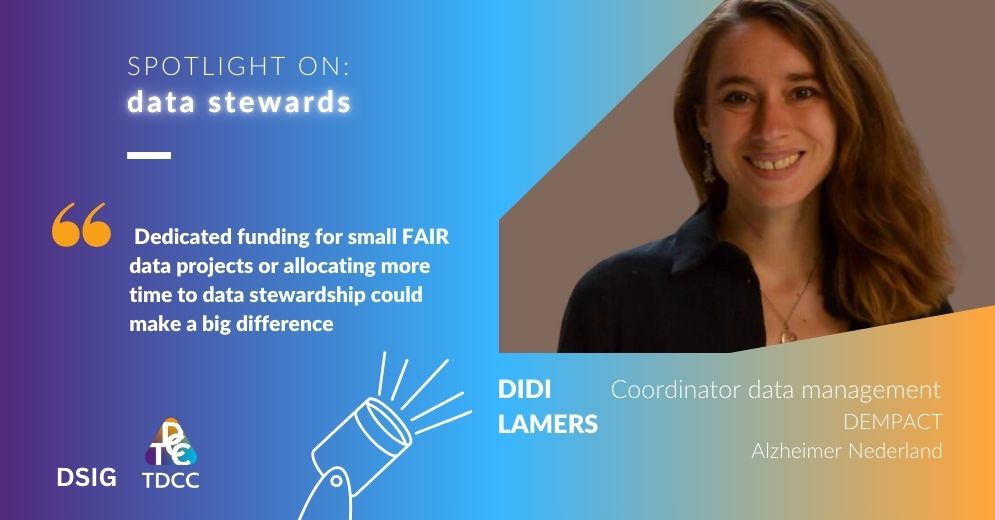
Spotlight on: Didi Lamers
Every other week, the Thematic DCCs and the Data Steward Interest Group (DSIG) put the spotlight on one research data steward working in the Netherlands to stimulate knowledge exchange and peer-to-peer learning.
What drew you towards the research data management field?
I have always been passionate about science and was certain I wanted to pursue a career in academia. However, during my PhD in neurobiology, I started noticing issues in how research was conducted. Researchers often need to focus on publishing papers and securing funding to succeed in academia, which means important aspects like sharing data, software, and protocols can be overlooked. I increasingly got the feeling that this compromised the quality and reproducibility of published research.
By the end of my PhD, I realised that rather than working within a system I didn’t fully believe in, I wanted to contribute in a way that could help improve the research process. This led me to explore more policy-oriented roles, and eventually I became a central data steward at Radboud University. It was a great fit—allowing me to stay close to science while working on making it more open and reliable. After a few years at Radboud University, I moved into my current role as coordinator for data management across several dementia research consortia. This position enables me to support better research practices while learning a lot about scientific research in dementia.
What is an activity/task of your role that you find yourself looking forward to?
I really enjoy talking to researchers from different disciplines about their work and the challenges they face in making their data FAIR. These conversations are often inspiring. Sometimes researchers become very enthusiastic, and together we come up with ideas for activities that could help make more dementia data FAIR. Those are the best moments, when there’s a sense of shared energy and motivation to take action.
I also appreciate that these discussions allow me to learn so much about the wide range of research happening in the dementia field.
What is something unexpected that you can offer help with, if a colleague reaches out to you?
One thing I can help with is organising neuroscience (imaging or electrophysiological) data according to the Brain Imaging Data Structure (BIDS).
At the end of my PhD, our lab closed due to COVID restrictions, which meant I could no longer continue my experiments. To make the most of the data I had already collected, I decided to improve my programming skills and write better analysis scripts. This led to an internship at the Donders Institute, where I developed scripts to transform EEG data into BIDS format to enhance the reproducibility of developmental EEG research.
What do you think your community of research data professionals is missing?
Time and funding. Many researchers I speak with recognise the importance of managing their data better and making data more FAIR, but FAIR and open data are often just one of many tasks researchers have to juggle. Most of the researchers I’ve talked to handle most of these data management tasks themselves. Occasionally, a data steward is appointed to a large project, but even then, that person usually doesn’t have enough time to go beyond meeting basic requirements.
As a result, FAIR data often becomes something that needs to be done alongside all other responsibilities, and it rarely gets prioritised enough to make data truly reusable. Dedicated funding for small FAIR data projects or allocating more time to data stewardship could make a big difference in improving this situation.
What is a topic you would want to collaborate on with others?
One topic I would really like to collaborate on is the legal challenges in making data FAIR. Almost every researcher I’ve spoken to mentions that legal aspects of data management are a major challenge when it comes to recruiting participants, collaborating on research data, or sharing and reusing data. Setting up legal agreements often requires coordination between researchers, data stewards, and legal experts from multiple institutions.
Currently, there don’t seem to be overarching agreements between institutes on what these agreements should include. In some cases, strict interpretations by legal experts mean that existing agreements don’t allow data to be shared, linked, or used as researchers would like. As a research data professional, I can help by spreading best practices, but beyond that, my influence is limited. This is why I think it would be valuable for research data professionals, institutions, and legal experts to work together on creating more consistent and practical solutions.
How would you like to see your current field of work evolve in the next 5 years?
I see many promising initiatives by researchers, funders, and even companies to tackle FAIR data challenges in dementia research. However, at the moment, these efforts often operate in isolation and don’t always connect with each other.
In the next five years, I hope these initiatives will come together to create a more integrated and interoperable landscape, where data of all types can be reused and combined to answer new research questions.
Get in touch with Didi on ORCID | LinkedIn
Do you want to read other interviews published in the Spotlight on series? Visit the series' page.