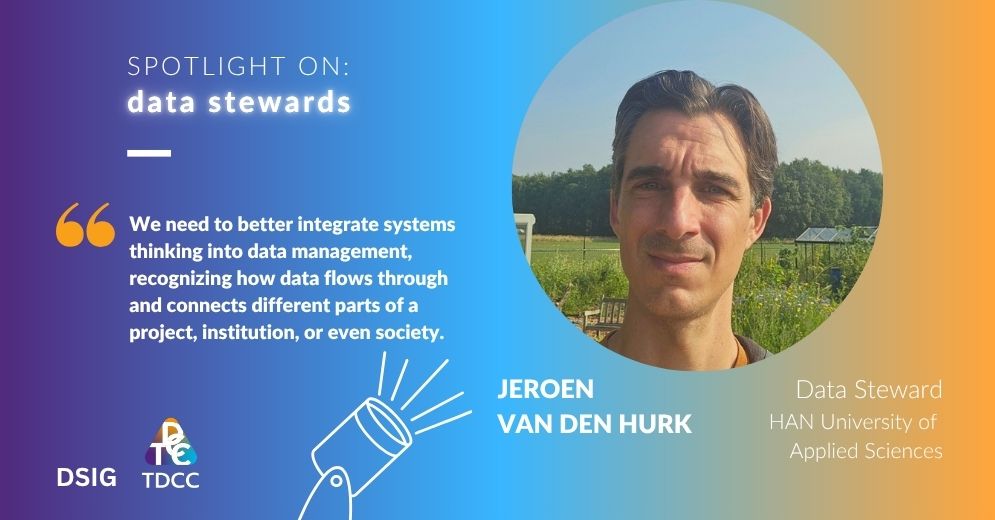
Spotlight on: Jeroen van den Hurk
Every other week, the Thematic DCCs and the Data Steward Interest Group (DSIG) put the spotlight on one research data steward working in the Netherlands to stimulate knowledge exchange and peer-to-peer learning.
What drew you towards the research data management field?
My first real experience with data was during my first scientific job working at the Centre for Research and Conservation in Antwerp. Everything was still recorded using USB sticks and local computers. After many years in research, I became acutely aware of how much time and effort is lost due to poorly managed data—whether it was searching for missing datasets, dealing with inconsistent file formats, or struggling to meet journal or funder requirements. I was drawn to research data management because I saw an opportunity to prevent these frustrations and help researchers focus on what they do best: generating new knowledge (whilst including old knowledge if possible). My own experiences with data challenges made me passionate about creating systems and support that make research more efficient, reproducible, and impactful.
What is an activity/task of your role that you find yourself looking forward to?
Having been a researcher myself, I understand the realities of lab work, field studies, and tight deadlines. I look forward to conversations where I can translate complex requirements into actionable steps, and when researchers realize that good data management can actually save them time and open up new opportunities for collaboration or funding. It’s rewarding to see the “lightbulb moment” when someone shifts from seeing data management as a burden to recognizing its value.
What is something unexpected that you can offer help with, if a colleague reaches out to you?
Beyond my work in research data management, I’ve designed and managed a small-scale food forest—a project that has given me unexpected, practical insights into sustainable systems and and project management. If a colleague reaches out, I could offer help with setting up a small scale system (food forest/ syntropic) for self sufficiency.
What do you think your community of research data professionals is missing?
RDM often focuses on data in isolation, but research—like a food forest—is part of a larger ecosystem. We need to better integrate systems thinking into data management, recognizing how data flows through and connects different parts of a project, institution, or even society. This could help us design more sustainable, scalable, and user-friendly data practices.
While the RDM community has made great strides, there’s still a gap in practical, hands-on support for research software management. Many researchers struggle with software sustainability, licensing, and integration with data management plans. Additionally, there’s a need for more institutional policies and infrastructure that recognize software as a first-class research output, alongside data and publications.
What is a topic you would want to collaborate on with others?
There’s a growing need for software that not only manages data but also ensures it’s Findable, Accessible, Interoperable, and Reusable (FAIR) by default. I’m eager to collaborate on projects that embed these principles into software design, making compliance effortless for researchers.
Could you point us to a resource, learning platform, tool or similar which you find useful or inspirational?
The Research Software Directory is an indispensable resource for data stewards in the Netherlands, offering a centralized, trusted platform for discovering, evaluating, and promoting research software. The directory provides a curated, peer-reviewed collection of research software, making it an ideal starting point for data stewards seeking reliable tools for their researchers.
Get in touch with Jeroen on LinkedIn
Do you want to read other interviews published in the Spotlight on series? Visit the series' page.
Are you a data steward or data professional who wants to be featured in one of the future editions? Fill out this form.